
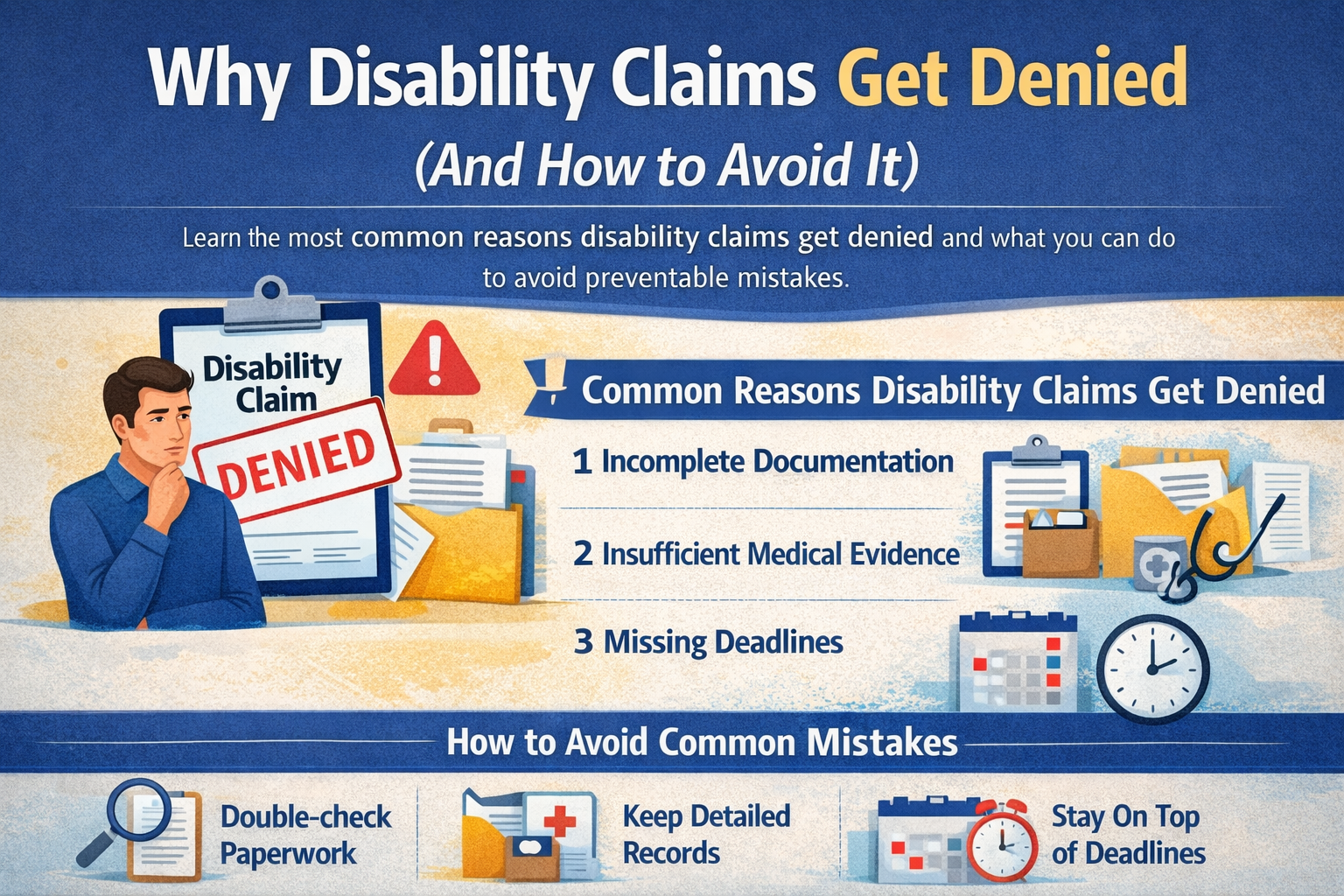
Why Disability Claims Get Denied (And How to Avoid It)
One of the hardest parts of the disability process is realizing how common denials really are.
A lot of people think:
“If I’m truly disabled, I should get approved.”
But Social Security doesn’t work from sympathy. It works from documentation, rules, and consistency.
This guide is part of our Denials & Appeals section, where we explain why claims get denied and how the appeals process works.
The biggest reason claims get denied
The biggest reason is simple:
The file does not clearly prove disability under Social Security’s rules.
That doesn’t always mean the person isn’t disabled.
It often means the evidence didn’t clearly connect the condition to the person’s inability to work.
Common denial reasons
Lack of medical evidence
If your records are too thin, too old, too inconsistent, or don’t clearly explain your limitations, your case gets weaker.
Incomplete application
Missing details, vague answers, and unclear work history can cause problems fast.
Not following treatment
If records suggest treatment could improve your condition but you’re not following through, Social Security may use that against you.
Working too much
If your earnings are too high, the system may assume you are able to work at a substantial level.
Technical problems
Sometimes a claim is denied for non-medical reasons like work credits or income limits.
Why first applications often fail
The truth is, many applicants do not fully understand what Social Security is evaluating.
They talk about symptoms, but not function.
They list diagnoses, but not work limitations.
They submit records, but don’t realize the records need to show specific kinds of evidence.
This is where many claims lose strength.
Can these mistakes be avoided?
A lot of them can.
Not all denials are preventable, but many are.
A stronger case usually comes from:
- Better documentation
- More complete forms
- Consistent treatment
- Clear descriptions of limitations
That’s why it helps to understand how to apply for disability benefits step-by-step instead of rushing the process.
Final Thoughts
Disability claims are often denied because the case was not clearly built to match Social Security’s rules.
That’s frustrating, but it also means some denials are fixable.
The more you understand the process upfront, the less likely you are to make the kinds of mistakes that lead to preventable denials.
